Published 27 October 2026

Older homes are part of Greater Manchester’s character, from Victorian terraces and Edwardian semis to interwar houses. Age alone does not mean a property is defective. It does mean that original materials, decades of maintenance and later alterations need to be understood together.
For a buyer, the aim is to identify what is visible, what documents or specialist checks are needed and which repairs should be budgeted before committing. The examples below are common areas to review, not a diagnosis of any particular house.
Roofs, chimneys and rainwater goods
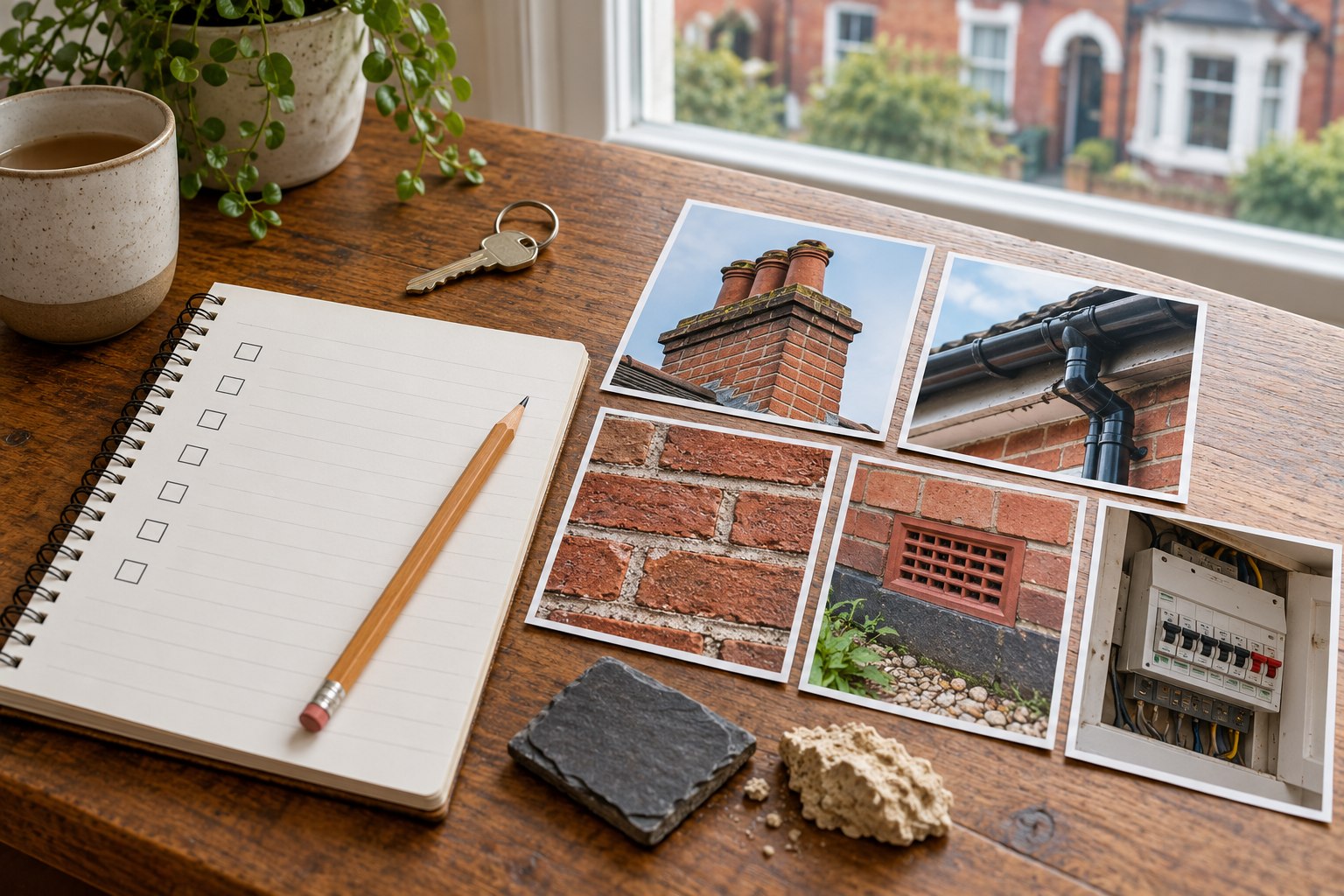
Slate or tiled roofs, chimney stacks, flashings, gutters and downpipes have all had long exposure to North West weather. From ground level, look for slipped or missing coverings, visibly open joints, vegetation, staining below gutters and water escaping during rain. Do not climb onto a roof.
A small rainwater defect can affect more than one part of the building. Historic England says regular inspection and maintenance of rainwater systems helps protect buildings from deterioration caused by water penetration. Ask whether high-level access is required, because some gutters and roof details cannot be assessed properly from the ground.
Brickwork, pointing and exterior finishes
Manchester’s older brick homes may show weathered joints, previous patch repairs, local cracking or render over earlier masonry. Note the location and extent rather than assuming the cause. Dated photographs are useful where limited cracking needs monitoring.
Traditional construction can absorb, store and later release moisture. Historic England warns that modern moisture-resistant materials are not always suitable for traditionally constructed walls. Before wholesale repointing, rendering or damp treatment, establish the wall construction and ask whether the proposed materials are compatible. A leaking gutter or pipe may need attention before the wall finish.
Damp-looking marks and ventilation
Staining, mould, damaged plaster or musty smells deserve investigation, but one symptom does not prove one cause. Excess moisture may relate to building defects, services, drains, groundwater, ventilation or how the home is used. Historic England’s joint guidance stresses diagnosis before treatment because work aimed only at the symptom can waste money or make matters worse.
Look for blocked air bricks, poor airflow around stored items, condensation and signs of leaks, while keeping your observations factual. Do not assume every low-level mark requires an injected damp-proof course. If the cause is unclear, arrange a suitable moisture investigation by someone experienced with the building type.
Floors, joinery and concealed timber
Older houses may have suspended timber floors, later solid floors or a mixture created by extensions and alterations. Unevenness, movement, damaged skirting or blocked sub-floor vents can justify closer attention. The visible surface cannot confirm the condition of concealed joists or wall plates.
Record areas that could not be inspected. Opening-up requires the owner’s permission and an agreed scope; a visual visit cannot confirm hidden timber is sound.
Past alterations and removed walls
Many older Manchester homes have been opened up, extended, reroofed or had chimney breasts altered. Ask your conveyancer for available approvals, guarantees and supporting documents. A lack of paperwork does not by itself establish whether work is defective, and a visual inspection cannot verify concealed beams, bearings or foundations.
If there is visible movement, unusual support or a survey recommendation for structural advice, keep that recommendation visible. A structural engineer may be needed to assess the arrangement and specify further investigation.
Electrical, gas and drainage services
A standard home survey does not test electrical safety. Electrical Safety First advises buyers not to rely on the survey for this and to use a registered electrician where the installation needs assessment. Ask about the age of the consumer unit, available certificates and the scope of any proposed Electrical Installation Condition Report.
Gas appliances and flues need the appropriate Gas Safe advice. Drainage concerns may require a separate inspection. Do not treat a recently decorated room or modern fitting as evidence that the underlying services have been renewed.
Choose the right follow-up
Start with the complete survey and its limitations. Our Level 2 survey warnings guide explains how to organise questions and preserve recommended investigations. If you already have a Level 2 or Level 3 report and need help understanding indicative repair allowances, Casa’s UK-wide Survey Cost Review may be suitable.
For accessible visible concerns in Greater Manchester and nearby Cheshire, our visual home inspections provide a builder-led follow-up within an agreed scope. They do not replace a RICS survey, structural assessment or specialist testing. To discuss the property, request a home inspection and include the relevant report sections, photographs and questions.
An older home can be a sound purchase, but its history should be read carefully. Separate visible maintenance, unresolved uncertainty and specialist advice so that your decision reflects the actual property rather than its age alone.
Sources
Historic England, “Inspection, Maintenance and Repair of Rainwater Systems”, checked 27 October 2026: https://historicengland.org.uk/advice/technical-advice/retrofit-and-energy-efficiency-in-historic-buildings/resilient-rainwater-systems/inspection-maintenance-and-repair-of-rainwater-systems/
Historic England, “Investigation of Moisture and its Effects on Traditional Buildings”, checked 27 October 2026: https://historicengland.org.uk/advice/technical-advice/buildings/damp-in-historic-buildings/investigation-of-moisture-and-its-effects-on-traditional-buildings/
Electrical Safety First, “Home buyers”, checked 27 October 2026: https://www.electricalsafetyfirst.org.uk/safety-advice/home-and-people/home-buyers/